Thursday, 21 April 2016

4. CRISTIANO RONALDO

Cristiano Ronaldo is a professional soccer player who has set records while playing for both Manchester United and Real Madrid.Cristiano Ronaldo was born on February 5, 1985, in Funchal, Madeira, Portugal. Manchester United paid £12 million to sign him in 2003—a record fee for a player of his age. In the 2004 FA Cup final, he scored Manchester's first three goals and helped them capture the championship. In 2008, he set a franchise record for goals scored. In 2009, Real Madrid paid a record $131 million for his services.By his early teens, Ronaldo's talent and legend had grown considerably. After a stint with Nacional da liha da Madeira, he signed with Sporting Portugal in 2001. That same year, at the tender age of 16, Ronaldo turned heads with a mesmerizing performance against Manchester United, wowing even his opponents with his footwork and deft skill. He made such an impression that a number of United players asked their manager to try and sign the young player. It wasn't long before the club paid Ronaldo's team more than £12 million for his services - a record fee for a player of his age.
Success with Manchester United

Ronaldo, however, did not disappoint. He showed his promise early on in the 2004 FA Cup final, scoring the team's first three goals and helping them capture the championship. In 2008, a year after signing a five-year, £31 million contract, Ronaldo again justified the high tab when he put together one of the club's finest seasons in history, setting a franchise record for goals scored (42), and earning himself the FIFA World of the Year honor. In all, Ronaldo helped steer Manchester United to three premier league titles.
But Ronaldo's time in England was marred by his mother's 2007 struggle with breast cancer as well as his father's death from alcohol-related illness. The latter was especially hard for Ronaldo as the two had been close, and the young athlete had often pushed for his father to enter rehab and address his drinking. His father, however, never accepted the offer.

Departure to Real Madrid

As lauded as Ronaldo was on the field for Manchester United, his commitment to the club came under constant question. Speculation swirled that he wanted to play elsewhere. So in 2009, when Spanish soccer club Real Madrid agreed to pay United a record $131 million for the chance to sign him, nobody was all that surprised to see Ronaldo leave United.
"I know that they are going to demand a lot of me to be successful at the club and I know that I'm going to have much more pressure than at Manchester United because I was there for many years," Ronaldo told reporters. "But it means a new challenge and is going to help me be the best footballer."
In addition to his FIFA World Player of the year award, Ronaldo has also won the coveted Ballon d'OR, the Golden Boot, and been named the UEFA Club Forward of the Year, among other honors during the course of his career.

3. LIONEL MESSI


Lionel Messi is the heir apparent to the throne left vacant by Diego Armando Maradona. The waters are divided between those who consider him to be far from being the best No. 10, and those who believe that Messi will be even better than Maradona.
Born in Rosario, he cut his teeth in the youth ranks of Newell's Old Boys, until a hormonal problem that affected his growth changed the plans of his family and, of course, his personal future. Facing expensive treatment for their son, Messi's parents moved to Spain as Newell's were not able to afford the medical costs related to his condition, and even the wealthiest Argentine teams, such as River Plate, refused to foot the bill.
After his first trial with Barcelona, the Catalan coaches had no doubts. They decided to sign Messi and pay for his medical treatment. His growth was noticeable within Barca, and in little time he came to be considered one of the great talents at the club. He made his debut in the first division in October 2004, against Espanyol, and Barcelona have since adopted him as one of their greatest idols.
His first championship would come in the Liga season of 2004-05. Since then, and playing a more prominent role every season, he has won every major club trophy at Camp Nou -- including a stunning haul of six in 2008-09 -- and claimed the World Player of the Year [later the FIFA Ballon d'Or] award four times in four years.
Messi has proven his credentials on the biggest stage with goals in two of the three Champions League finals he has won with Barcelona, with his achievements leaving many in little doubt that he is the best player of his generation; possibly of all time.
That idea was given further weight in March 2012 when, at the age of 24, he became the all-time top scorer at Barcelona -- beating the 232 goals of Cesar Rodriguez.
The forward's hat-trick in Barcelona's 4-3 win over Real Madrid in March 2014 also saw him become the all-time top scorer in El Clasico clashes.
Messi endured criticism over his performances during the 2013-14 campaign despite scoring 28 goals in 31 Liga appearances as Barcelona lost the title to Atletico Madrid in a dramatic final day clash, but the forward committed his long-term future to the club with a new deal in May 2014 and came back with a bang to claim the Treble of La Liga, Champions League and Copa del Rey after scoring 43 goals in 38 games.
As the top scorer for Barcelona, and still under the age of 30, Messi is simply one of the best there has ever been.
Strengths: His ball skills are second to none, his runs from midfield are usually lethal and he is almost impossible to tackle when he gets his head down. His balance when running at speed is incredible.
Weaknesses: Too often he searches for a way to finish moves by himself without looking for teammates in a better position to shoot at goal.

2. DIEGO MARADONA

                  Soccer great Diego Maradona led Argentina to victory in the 1986 World Cup, though his accomplishments were later overshadowed by his battles with drug abuse.
Diego Armando Maradona was born on October 30, 1960, in Buenos Aires, Argentina. Maradona led club teams to championships in Argentina, Italy and Spain, and famously starred for the Argentinean team that won the 1986 World Cup. A short but fearless midfielder renowned for his ability to create scoring chances for himself and others, Maradona led club teams to championships in Argentina, Italy and Spain.
The pinnacle of his career came as a member of the Argentinean national team that won the 1986 World Cup. His performance there included two memorable goals in a quarter-final victory over England: The first was scored illegally with his left hand, which Maradona later claimed was the work of "the hand of God"; the second required no supernatural help, other than an otherworldly ability to dribble past an onslaught of defenders to find the back of the net. Altogether, Maradona played in four World Cups, and scored an impressive 34 goals in 91 international appearances for Argentina.
Despite his unquestioned brilliance on the pitch, the emotional Maradona became equally well known as a highly controversial figure. He became addicted to cocaine while playing in Spain in the 1980s and received a 15-month suspension after testing positive for the substance in 1991. Maradona endured another high-profile suspension three years later, this time for testing positive for ephedrine during the World Cup.

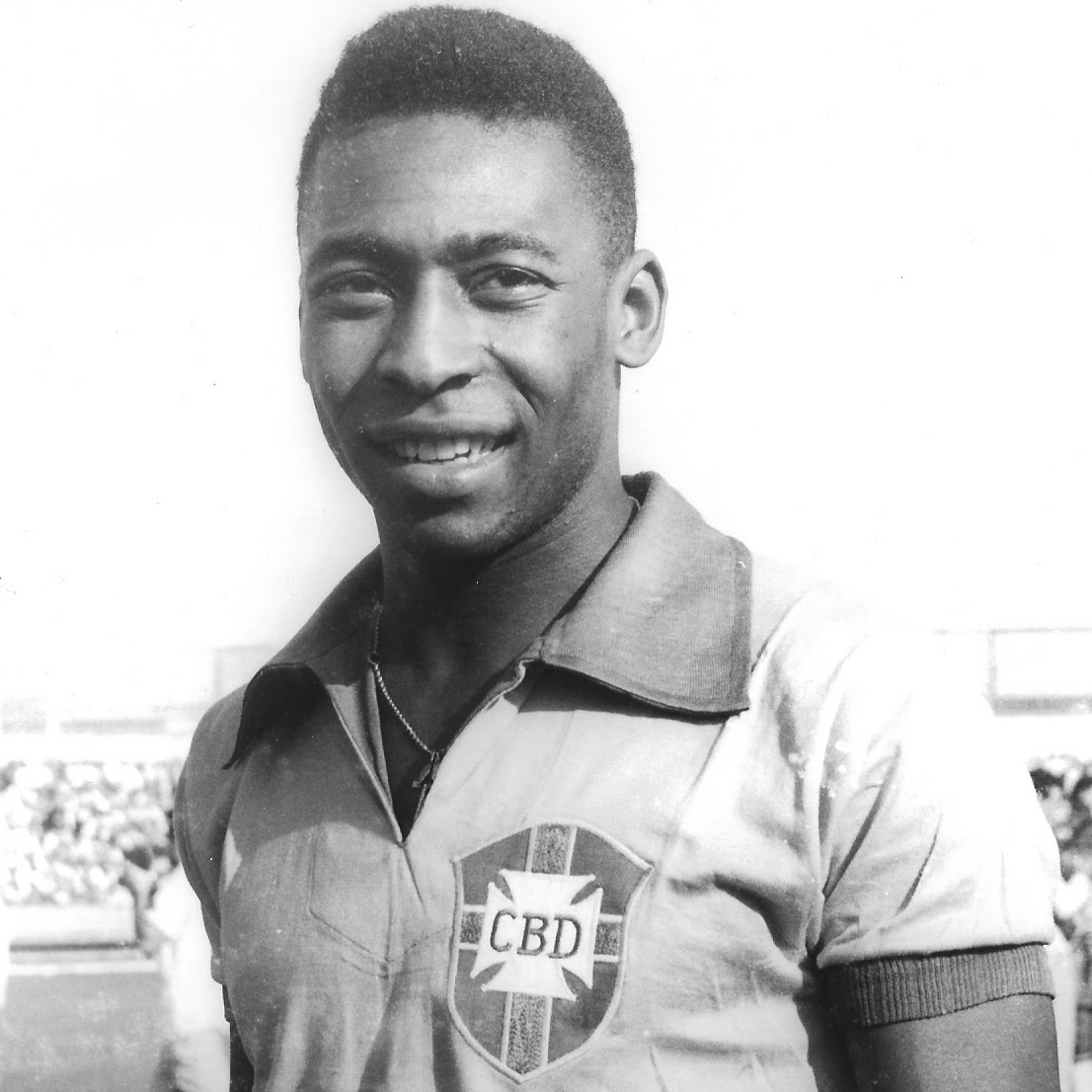
1. PELE

                   
     Pelé started his professional career at the age of 16 for Santos Futebol Clube, a club he stayed with for nearly two decades. In 1958, he won his first World Cup for Brazil at age 17 – the youngest winner ever. He went on to win another two World Cups in 1962 and 1970, making him the only person in the world today with three Jules Rimet trophies to his name. Not only is Pelé the all-time leading scorer of Santos FC and the Brazil National Team, but he is the all-time leading scorer in the history of the sport (1283 goals in 1366 matches).In 1974, Pelé came out of semi-retirement to sign with the New York Cosmos for the 1975-1977 seasons and led his team to the 1977 NASL championship. After his final career match on October 1, 1977 in front of more than 75,000 fans, Pelé shouted, “Love! Love! Love!” and urged his audience to pay attention to the youth of the world. Pelé will never forget where he came from and has a never-ending desire to give back.From his humble beginnings, to his unmatched athletic feats, to his post-career influence and impact on every continent – Pelé lives with great honor and pride of his birthplace (Três Corações means Three Hearts) in that, “Where I was born, where I grew up and where I played football – they have given me three hearts too.”Named one of the “Top 20 Most Important People of the 20th Century” (Time Magazine) and “Football Player of the Century” (FIFA), Pelé today maintains his commitment to the sport and to society by fulfilling various roles as spokesperson, ambassador and philanthropist.